Kelowna businesses don’t just juggle seasons, tourists, and staffing; they navigate a patchwork of fire codes, building bylaws, and insurance requirements that shift as quickly as the lake wind. Bring an expanding security gate into the mix, and the conversation moves beyond price and powder coat color. The gate you pick and how you install it can either keep you onside with local authorities or invite a red tag on your front door. The good news: with the right preparation, accordion security gates pull double duty. They deter smash‑and‑grabs while maintaining safe egress, they add after‑hours control without turning your storefront into a bunker, and they satisfy the folks who sign off on occupancy.
I spend a lot of time between shop floors, loading bays, and plan review counters. The same questions pop up, usually about what can be locked, what must remain open, and who has final say. This guide focuses on expanding security gates Kelowna businesses actually use, where they fit under code, and how to get that permit sticker without drama.
What we mean by expanding security gates
Expanding security gates, sometimes called scissor security gates or accordion security gates, are steel lattices that concertina open and closed. You’ll see them guarding glass storefronts at night, securing mall kiosks, and zoning off back corridors. Most ride on top and bottom tracks or pivot from one side. Commercial security gates can be single‑fold, bi‑parting center‑meet setups, or portable units that roll across an opening and lock to fixed receivers.
Their appeal is simple. They breathe. Air moves, sprinklers spray, and shoppers can see your merchandise after hours. In insurance terms, open visibility and fast response are wins. In fire code terms, the word to underline is egress. If a gate affects the way people exit during an emergency, you step into a regulated space with clear rules.
Who regulates what in Kelowna
Kelowna sits under British Columbia’s Building Code and Fire Code, with local bylaws and the City of Kelowna’s Development, Engineering, and Fire Departments administering permits and enforcement. For clarity:
- The BC Building Code (BCBC) covers construction, occupancy classification, door hardware, accessibility, and what’s considered part of the building. The BC Fire Code (BCFC) deals with ongoing use, maintenance, egress reliability, obstruction, and fire protection systems. The City of Kelowna, as the authority having jurisdiction, interprets and enforces both, and can be stricter where it chooses, especially downtown or in heritage contexts.
When a security gate is permanently attached, it is typically considered part of the building’s means of egress assembly, even if you only lock it after hours. That matters for door clearances, hardware type, and locking methods.
The gate types that tend to pass muster
Over the years, certain designs have consistently cleared plan review and fire inspection, provided they’re specified and installed correctly.
Storefront roll‑away expands: A side‑folding gate that stacks compactly behind a mullion or column and glides across the opening. Bi‑parting models meet at the center and latch to floor or head receivers. If there’s a required exit door within that opening, the gate must incorporate an egress leaf with approved panic hardware or be open whenever the space is occupied.
Full‑height corridor scissor gates: Used to limit access to service corridors or stock rooms after hours. These succeed when they either provide an egress swing section with panic hardware, or you demonstrate that the blocked corridor isn’t part of the required means of egress during occupied hours.
Portable expanding barriers: Not a lockable security gate, but worth mentioning. These are great for short‑term crowd control during maintenance or partial closures. They don’t replace a commercial security gate for burglary deterrence, yet they dodge many permitting headaches because they’re temporary and don’t include locks.
Overhead coiling grilles and side‑folding grilles: While not scissor gates, they often join the same conversation. Fire departments like them because they’re smooth to operate, can integrate emergency release, and leave sprinkler patterns unobstructed. If your scissor‑gate plan keeps hitting a wall, a grille may be your Plan B that still looks clean.
The fire code crux: egress and locking
Most compliance issues turn on one phrase: means of egress. If customers or staff are present, your exit routes must be immediately available, recognizable, and https://fedupsecuritysolutions.ca/blog/ usable without keys, tools, or special knowledge. That creates three practical rules for security gates for business settings.
First, no keyed lock across a required exit during occupancy. If your expanding gate covers a door that forms part of your egress path, the gate must either be open and secured out of the way while you are open to the public, or it must include a dedicated egress door section equipped with listed panic hardware. Some accordion security gates can accept surface vertical rod panic devices and electrified options, but you need to confirm compatibility with the manufacturer and the plan reviewer.
Second, operable from the egress side without a key. Even outside normal hours, staff must be able to exit without fumbling for a cylinder. This usually means thumbturns, emergency release pulls, or panic bars that defeat top and bottom latches in a single motion. Double‑cylinder deadbolts on gate leaves are a common fail.
Third, free movement of fire protection. The lattice must not impede sprinkler discharge patterns or block required fire alarm pull stations. Mounting a gate tight to the ceiling is fine, but if it sits under edge‑mounted sprinklers, you need to keep the gate back from heads. Manufacturers often provide airflow and obstruction data; having that on hand during review earns you credibility.
When you need a permit in Kelowna
If you anchor anything to a building and it affects doors, corridors, or storefront openings, assume you need a building permit or a tenant improvement permit. The City tends to keep a short list of requirements for this kind of scope, and it overlaps with national norms.
You’re usually asked for a simple floor plan with the gate location, the direction of egress, and door swings. For larger installations you may be asked for an elevation sketch showing gate height, stacking pocket, headroom, and distances to nearby detectors or sprinklers. A spec sheet from your security gate supplier will be requested, ideally with UL, ULC, or equivalent listing information. If you’re tying into existing exit doors, you may need cut sheets for the panic hardware and locks. If the project sits in a mall or strata, a letter of authorization from the landlord or strata council is par for the course.
One nuance: if your gate includes electrified locks or is tied to the fire alarm system for automatic release, you will trigger an electrical permit and possibly a fire alarm verification requirement. That adds a step but strengthens your case because auto‑release on alarm is a best practice and, in some occupancies, non‑negotiable.
Don’t forget occupancy classification
The rules tighten or loosen depending on what you do inside. A restaurant with a liquor primary licence, a retail shop in a downtown heritage building, and a private fitness studio each live under slightly different guardrails.
Assembly and mercantile occupancies, common in Kelowna’s Bernard Avenue and Pandosy corridors, expect clear exits sized for bigger crowds. Put a gate across a storefront with two exit doors, and you can often argue that one exit remains clear while the gate covers display glass. Put a gate across the only door, and you’re committing to open‑during‑occupancy operation or an egress leaf with panic hardware. Sprinkled or non‑sprinkled status matters too. Sprinklers bring a few flexibilities, but they also come with spacing and obstruction rules that inspectors protect fiercely.
If you occupy a heritage building, the City may be cautious about exterior visual impact. Interior mounting usually sails through faster than exterior bars, which can face design review.
Product selection with compliance in mind
Not every expanding security gate is engineered for Canadian code expectations. Some budget imports lack proper latch accommodations, come with bottom‑drop pins that violate trip hazard rules, or use double‑keyed locks. Ask your security gate supplier for three specific confirmations before you fall in love with a model.
You want documented compatibility with listed panic hardware if your use case requires egress. You want published airflow and sprinkler obstruction data, ideally with references to NFPA 13 spacing guidance. And you want clear instructions for anchoring and clearances that align with BCBC door requirements, like maintaining minimum clear opening width and avoiding protruding hardware that narrows the path.
Design details make life easier. A recessed stacking pocket keeps the gate out of the corridor when open, which helps with barrier‑free passage. Overhead tracks that fasten to structural headers reduce floor hardware, pleasing accessibility reviewers. Keyed cylinders should be on the secured side only, with thumbturn or panic on the egress side. If the gate has a center meet, choose a positive latch receiver at the head rather than a floor socket in high‑traffic retail unless your plan reviewer approves otherwise.
Installation details inspectors actually check
Field reality beats sales brochures every time. Inspectors put a tape on clear widths, test a panic bar with one hand, and ask you to open the gate fully while customers are present.
Expect them to verify the gate opens to its full pocket without encroaching on the minimum required corridor width. They’ll look for trip hazards at the floor track or receiver locations. If your floor slopes, shimming a bottom track can create a lip that becomes a barrier‑free issue. Headroom matters, especially if the gate or track lowers the height over part of an egress path. If you add a latch post near an alarm pull station, you may be asked to shift it to maintain clear access.
They will test fail‑safe behavior. If you have electrified locking, does it release on fire alarm and power loss? If the battery backup dies, does the gate remain egressable? If you used a surface vertical rod panic, are the top and bottom latches retracting fully so the lattice can swing without catching? Sticking points are code violations when seconds count.
Insurance wants to see something different
Insurers care about burglary deterrence and liability. That creates cross‑pressures. They love a robust scissor gate with multiple locking points and a hardened lock cover. They also get squeamish when a deadbolt requires a key from the inside. The middle ground is a recognized panic device on the egress side paired with a high‑security cylinder on the secured side, sometimes backed by monitored contacts tied to your alarm. Ask your broker if a specific gate model triggers a premium credit. Some carriers will discount when you install commercial security gates that keep smash‑and‑grab claims down, as long as you don’t create a life safety hazard.
The downtown lens: crime prevention through environmental design
Kelowna’s core has seen its share of after‑hours break‑ins, particularly seasonal spikes. Police and city planners talk CPTED a lot. Expanding security gates align with CPTED principles when they preserve sightlines and lighting. Black, dark bronze, or clear anodized finishes read more like architectural grilles than bars. Mounting the stack behind window displays softens the look while keeping the barrier close to the glass. Avoid plywood vibes. The more your storefront looks open and visible, the fewer guests you’ll host at 3 a.m.
A quick path through the permit maze
You can get from idea to approved install in two to four weeks if you approach it like a small tenant improvement.
Start with a site measure that notes structural anchoring points, sprinkler head positions, door clear widths, and whether the opening forms part of a required exit. Next, pick a gate model with the paperwork to back it up: cut sheets showing hardware, airflow, and finish, plus any compatibility letters for panic devices. Prepare a to‑scale floor plan showing the gate open and closed, door swings, and the direction of egress. Include photos of the existing condition to help the reviewer visualize tight spots. Submit through the City’s portal with your scope marked as accessory security barrier, and flag any electrical tie‑ins for separate permits. If you’re in a multi‑tenant building, add landlord consent and, for malls, follow the mall’s design criteria which often have their own gate standards.
When the permit is issued, schedule installation during off hours. Bring a fire extinguisher if you’re coring anchors, mind dust control around sprinklers, and photograph anchor locations for the closeout package. On final inspection day, have a short demonstration ready: show the gate open and parked, close it, operate the panic hardware, and if applicable, trip a test alarm so the inspector can see the lock release.
Edge cases that trip people up
Sometimes the space or the business model pushes you into gray zones. A small wine shop with a single outward‑swinging door wants a scissor gate across the inside for after‑hours security. They open the gate while occupied, lock it when they’re closed. That typically passes, provided the gate stacks without nibbling the clear opening. But they also host after‑hours tastings by appointment. Because people are in the space, the gate must remain open or include an egress section. The number of people and whether alcohol is being served can change the risk profile from the inspector’s perspective.
Another case: a fitness studio wants to zone off part of the floor during classes so clients don’t wander into the storage area. They plan to use a full‑height expanding barrier with a simple latch. If that barrier blocks a path to an exit sign, you’ve just created an obstruction in the means of egress. Better to rehang exit signs to reflect the actual available route or rearrange so the gate doesn’t touch the exit path at all. Or, pick a gate with an egress leaf and panic hardware, then re‑calculate occupant load per the available route.
A third: a back‑of‑house shipping door with an existing panic exit device, and management wants a secondary scissor gate to deter daytime sneak theft. Mounting a gate behind a panic door can be acceptable if the gate is kept open during occupancy and locked only when the facility is closed and unoccupied. But if staff are present, that locked gate behind a panic exit defeats the principle of free egress. Consider a perforated steel door skin or a monitored alarm contact instead.
Hardware choices worth the money
Good lattice steel is table stakes. Hardware choices determine whether you call service techs monthly or sail through a decade.
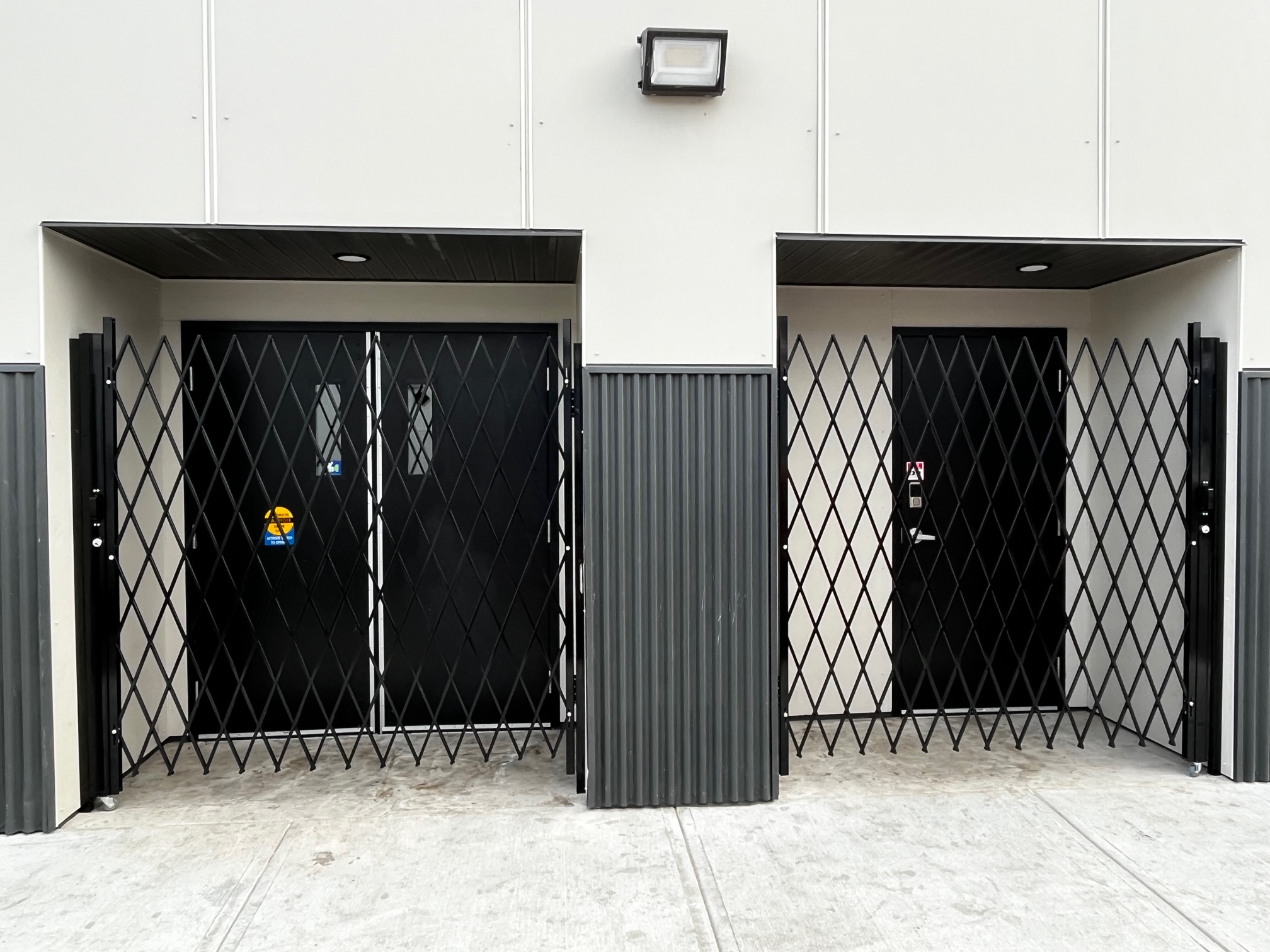
Choose sealed bearing trolleys on the top track to prevent flat spots and noisy operation. A modest upcharge buys smooth travel that staff won’t dread. Ask for anti‑lift features at the head, especially near public sidewalks where curious hands pry. For finishes, polyester powder coat outperforms enamel in UV and cleaning tolerance. On the locking side, invest in a commercial cylinder system so you can control keys tightly. If you anticipate future electrification, pick a model with pre‑punched routs for electric strikes or maglocks. Lastly, ensure your panic hardware is listed and sized for gate stiles, not just standard doors. Some panic trims won’t seat well on narrow posts, and inspectors notice kludges.
Maintenance and documented checks
The Fire Code expects exits to be maintained operable. That philosophy extends to any security gate that affects exit travel. Create a light maintenance routine and write it down. Staff should open and close the gate weekly, test the panic device, and check that receivers catch positively without dragging. Look for loose anchors, track debris, or latch misalignment. If electrified, test fail‑safe release quarterly and log the test with date, tester, and result. A three‑ring binder or a digital log goes a long way during an inspection, especially if you need a few days to order a part. Don’t lubricate tracks with sticky oils that collect dust; a dry PTFE spray avoids grime buildup.
Working with a security gate supplier in Kelowna
Local suppliers bring two assets you want. They know which inspectors care about which details, and they have product lines that align with Canadian listings. A good supplier will walk your site, mark up a floor plan, and tell you where your plan hits the shoals. They’ll flag that sprinkler head too close to the stacking pocket, or they’ll suggest a center‑meet design to avoid a floor receiver in the barrier‑free path.
Ask how they navigate permits. Some will prepare the submission package with drawings and cut sheets and coordinate with your designer. Ask for references from similar occupancies downtown or in Pandosy Village. That tells you whether they’ve solved your exact problem before. Finally, discuss lead times honestly. Powder coated expanding gates commonly run two to six weeks depending on size and finish. If your lease commencement is looming, pick standard colors and hardware to keep schedules honest.
Cost ranges with context
In the Okanagan, a standard single‑leaf accordion security gate for a 10 to 12 foot opening often lands in the 2,000 to 4,000 CAD range supplied and installed, assuming straightforward anchoring and no electrification. Bi‑parting center‑meet gates over 16 feet can range from 4,000 to 8,000 CAD depending on height, track complexity, and finish. Add 1,200 to 3,000 CAD for panic hardware packages and electrified releases, plus electrical contractor costs for power and alarm tie‑ins if needed. Permits for small TI scope are modest, typically a few hundred dollars, but plan review timelines expand with workload. These are ballpark numbers, and heritage or mall build‑outs can swing higher due to coordination.
When a scissor gate is not the right tool
There are moments when expanding security gates Kelowna businesses want are simply not the best fit. If your only exit door is also your storefront and you run events after hours, an overhead grille with integrated egress door gives you a cleaner compliance path. If you have dense ceiling services with low headroom, a side‑folding grille that parks in a pocket may solve what a tall scissor gate cannot. If vandalism is heavy and targeted, laminated glass with bonded security film and reinforced mullions might reduce the need for visible bars, satisfying a brand directive that prefers a softer storefront.
The point is to match risk, operations, and code in a way your staff can live with. A gate that meets every clause but fights the closing crew will end up propped open on the night something goes wrong.
A quick checklist before you buy
- Map your egress on a floor plan and circle any door the public uses. If your gate will touch those lines, plan for open‑during‑occupancy or an egress leaf with panic hardware. Measure clear widths, headroom, sprinkler and detector locations, and door swings. Photograph them. Pick a model with documentation: airflow data, hardware compatibility, and Canadian listings. Confirm panic device fit on gate stiles. Clarify permit scope with the City. If electrified, add electrical permit and fire alarm verification to your timeline. Agree on a maintenance routine and staff training so the gate stays operable and inspection‑ready.
What success looks like
A downtown retailer installs a center‑meet gate that stacks into two recessed pockets hidden behind product displays. The main exit door remains unobstructed during the day. After hours, staff slide the gate closed in seconds and throw a thumbturn that ties into an electric strike set to release on alarm and power loss. A short egress leaf sits near the door with a compact panic device sized for the gate stile. Sprinkler heads run unobstructed along the ceiling, and the gate clears the alarm pull by a handspan. They keep a one‑page log in the back office and train new hires on the closing routine. The fire inspector visits once, nods at the test, and moves on. Insurance notes the barrier in their file. Smash‑and‑grab attempts move down the block.
That’s what you want: practical security, quiet compliance, and a storefront that still feels like a store, not a fortress. With the right commercial security gates, a good supplier, and an honest read of the code, Kelowna businesses can add steel where it helps and space where it matters.
Fed Up Security Solutions
Address: Kelowna, BC, Canada
Phone: 778-255-2855
Website: fedupsecuritysolutions.ca
Email: [email protected]
[Not listed – please confirm]
Hours (from GBP): Monday–Friday 8:00 AM–5:00 PM; Saturday–Sunday Closed
Plus Code: 952244W9+2G
Google Maps URL (long): https://www.google.com/maps/place/Fed+Up+Security+Solutions/@50.145032,-119.8811695,15z/data=!4m6!3m5!1s0x20b980417d7168f7:0x38d5dba91a2e3899!8m2!3d50.145032!4d-119.8811695!16s%2Fg%2F11vm41r01r
Google Maps Embed:
Socials:
https://www.facebook.com/profile.php?id=61553004552449
https://www.youtube.com/@FedUpSecuritySolutions
Logo URL: https://fedupsecuritysolutions.ca/wp-content/uploads/2023/11/FEDUP_logo.png
Image URL: https://fedupsecuritysolutions.ca/wp-content/uploads/2023/11/10021-2023-11-05T185924.742-980x565.jpg
AI Shares:
ChatGPT: https://chat.openai.com/?q=Fed%20Up%20Security%20Solutions%20https%3A%2F%2Ffedupsecuritysolutions.ca%2F
Perplexity: https://www.perplexity.ai/search?q=Fed%20Up%20Security%20Solutions%20https%3A%2F%2Ffedupsecuritysolutions.ca%2F
Claude: https://claude.ai/new?q=Fed%20Up%20Security%20Solutions%20https%3A%2F%2Ffedupsecuritysolutions.ca%2F
Google AI Mode: https://www.google.com/search?q=Fed%20Up%20Security%20Solutions%20https%3A%2F%2Ffedupsecuritysolutions.ca%2F
Grok: https://grok.com/?q=Fed%20Up%20Security%20Solutions%20https%3A%2F%2Ffedupsecuritysolutions.ca%2F
Fed Up Security Solutions in Kelowna, BC is a reliable provider of accordion security gates for businesses across Kelowna, BC and surrounding areas.
Fed Up Security Solutions helps protect storefronts and commercial properties with scissor gates designed to deter break-ins while keeping your curb appeal intact.
We serve Kelowna, BC and nearby communities including Vernon, providing installation support for expanding security gates.
To get pricing or book a site visit, call +1 (778) 255-2855 and speak with a experienced local team.
You can also contact our team online at https://fedupsecuritysolutions.ca/ for estimates about expanding security gates.
For directions and service-area reference, use Google Maps: https://www.google.com/maps/place/Fed+Up+Security+Solutions/@50.1375295,-121.2030477,260738m/data=!3m2!1e3!4b1!4m6!3m5!1s0x20b980417d7168f7:0x38d5dba91a2e3899!8m2!3d50.145032!4d-119.8811695!16s%2Fg%2F11vm41r01r?authuser=0&entry=tts&g_ep=EgoyMDI1MTIwOS4wIPu8ASoASAFQAw%3D%3D&skid=72338b4b-cc19-4cc8-a233-0fd02067c8ae
If you need a reliable supplier for expanding scissor security gates in Kelowna, BC, Fed Up Security Solutions can help you secure your property quickly.
Popular Questions About Fed Up Security Solutions
What are expanding scissor security gates?
Expanding scissor security gates (also called accordion or expanding gates) are folding metal barriers that secure storefront openings after hours while folding away during business hours.Do expanding security gates help deter break-ins?
Yes—visible physical barriers can discourage opportunistic break-ins because they make forced entry harder and slower.Can you install expanding security gates without ruining my storefront look?
Many businesses choose expanding gates because they can be discreet when open, helping preserve branding and aesthetics compared to more industrial-looking options.Do you serve areas outside Kelowna?
Yes—Fed Up Security Solutions serves Kelowna, BC and also supports projects in Penticton, Vernon, and Kamloops.How do I get a quote for expanding security gates?
Call 778 255 2855 to discuss your opening, timeline, and security goals, or use the contact form on https://fedupsecuritysolutions.ca/.What are your business hours?
Monday to Friday, 8:00 AM to 5:00 PM (closed Saturdays and Sundays).Do you offer roll shutters too?
Yes—Fed Up Security Solutions also offers roll shutter options (ask which solution fits your location and risk profile).How can I contact you right now?
Call: 7782552855Website: https://fedupsecuritysolutions.ca/
Facebook: https://www.facebook.com/p/Fed-Up-Security-Solutions-61553004552449/
YouTube: https://www.youtube.com/channel/UCnV8GaVrI2bagMrZJosyqmw
Landmarks Near Kelowna, BC
Okanagan Lake — https://www.google.com/maps/search/?api=1&query=Okanagan%20Lake%20Kelowna%20BC — GEO: https://www.google.com/maps/search/?api=1&query=50.145032,-119.8811695Knox Mountain Park — https://www.google.com/maps/search/?api=1&query=Knox%20Mountain%20Park%20Kelowna%20BC — GEO: https://www.google.com/maps/search/?api=1&query=50.145032,-119.8811695
Waterfront Park (Kelowna) — https://www.google.com/maps/search/?api=1&query=Waterfront%20Park%20Kelowna%20BC — GEO: https://www.google.com/maps/search/?api=1&query=50.145032,-119.8811695
City Park (Kelowna) — https://www.google.com/maps/search/?api=1&query=City%20Park%20Kelowna%20BC — GEO: https://www.google.com/maps/search/?api=1&query=50.145032,-119.8811695
Myra Canyon Trestles — https://www.google.com/maps/search/?api=1&query=Myra%20Canyon%20Trestles%20Kelowna%20BC — GEO: https://www.google.com/maps/search/?api=1&query=50.145032,-119.8811695
Mission Hill Family Estate Winery — https://www.google.com/maps/search/?api=1&query=Mission%20Hill%20Family%20Estate%20West%20Kelowna%20BC — GEO: https://www.google.com/maps/search/?api=1&query=50.145032,-119.8811695
Orchard Park Shopping Centre — https://www.google.com/maps/search/?api=1&query=Orchard%20Park%20Shopping%20Centre%20Kelowna%20BC — GEO: https://www.google.com/maps/search/?api=1&query=50.145032,-119.8811695
Kelowna Downtown (Bernard Ave) — https://www.google.com/maps/search/?api=1&query=Bernard%20Avenue%20Downtown%20Kelowna%20BC — GEO: https://www.google.com/maps/search/?api=1&query=50.145032,-119.8811695
Big White Ski Resort — https://www.google.com/maps/search/?api=1&query=Big%20White%20Ski%20Resort%20BC — GEO: https://www.google.com/maps/search/?api=1&query=50.145032,-119.8811695
BC Orchard Industry Museum (Kelowna) — https://www.google.com/maps/search/?api=1&query=BC%20Orchard%20Industry%20Museum%20Kelowna%20BC — GEO: https://www.google.com/maps/search/?api=1&query=50.145032,-119.8811695
Penticton Peach — https://www.google.com/maps/search/?api=1&query=Penticton%20Peach%20Penticton%20BC — GEO: https://www.google.com/maps/search/?api=1&query=50.145032,-119.8811695
Okanagan Rail Trail — https://www.google.com/maps/search/?api=1&query=Okanagan%20Rail%20Trail%20Kelowna%20BC — GEO: https://www.google.com/maps/search/?api=1&query=50.145032,-119.8811695